
Full Day of Programming at Third-Annual ACBA Labor and Employment Law Symposium
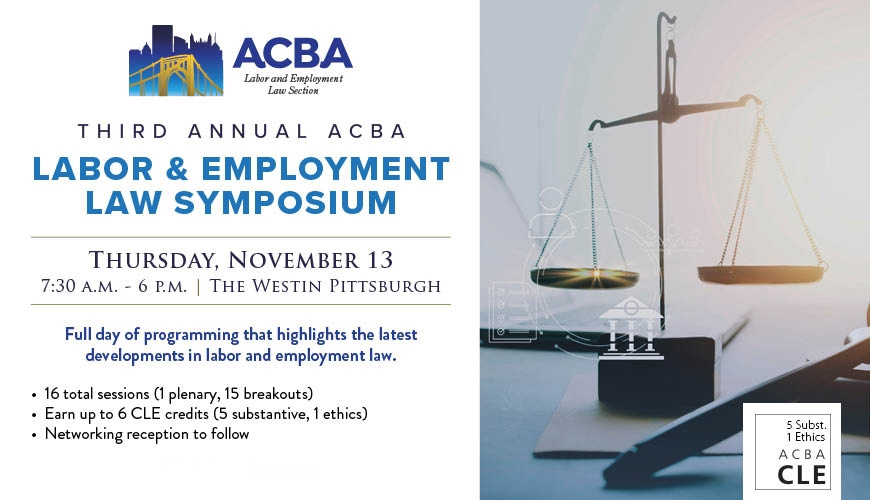
Looking for CLEs and programing examining the latest issues and hot topics in labor and employment law?
ACBA members as well as non-member attorneys are invited to the ACBA’s Third-Annual Labor and Employment Law Symposium. This robust, full-day symposium will feature a full day of programming that highlights the latest developments in labor and employment law.
Don’t miss this opportunity to earn 6 CLE credits (Option: 6 substantive credits, or 5 substantive and 1 ethics credit), network with colleagues and learn from experienced panelists. A distinguished panel of judges and seasoned practitioners will lead dynamic discussions on the latest developments shaping today’s labor and employment law landscape.
8:30 - 9:30 a.m. – Plenary Session
2025 Labor and Employment Law Year in Review
One substantive credit
This program will look at labor and employment developments from the past year, including open season on agency interpretation, and the EEOC shifting focus to protecting the majority, with statutes designed to protect the minority. The program will cover the courts wading into employee compensation issues; narrowing the scope of ADA coverage in protecting retiree benefits; lowering employers’ burden in asserting FLSA exceptions; and leveling the playing field for reverse discrimination actions and reduce the responsibility of employers for customer sexual harassment of their employees. Meanwhile, the program will cover Pennsylvania courts recognizing a claim for tortious interference with at-will contracts. The courts continue to trim the effect of non-compete provisions, enhance burden of showing public policy wrongful discharge tort actions, and clarify evidentiary burdens in whistleblower claims.
The 2025 year in employment and labor law continued the pattern of change and clarification (both landmark and less so) in the law of the workplace. Join an employee and employer attorney for a lively look at 2025's legal landscape in Pennsylvania, the Third Circuit (and elsewhere) while gazing into a crystal ball of where things go from here in labor and employment in the age of Trump.
Panelists:
- Samuel J. Cordes, Cordes and Associates
- Mark T. Phillis, Littler Mendelson
9:40 - 10:40 a.m. – Breakout Session 1
Real World ADA Issues
One substantive credit
Experienced panelists will discuss the ADA in terms of “real world” issues including an in-house perspective on advising clients on the appropriate path forward when faced with accommodation requests from employees; a plaintiff’s attorney’s perspective on advising clients who feel as though they have been denied leave or terminated in violation of the ADA; a defense attorney’s perspective on defending ADA claims; and a judge’s perspective on ADA issues which arise in her courtroom. Additionally, the panelists will provide an update on recent caselaw addressing accommodation requests in the context of return-to-work policies after COVID, and other new, emerging and scintillating ADA issues.
Panelists:
- Shelly R. Pagac, Houston Harbaugh
- Nicholas Kennedy, Kennedy Law
- Evan Jones, UPMC Corporate Legal Department
- Hon. Christy Criswell Wiegand, U.S. District Court for the Western District of Pennsylvani
9:40 - 10:40 a.m. – Breakout Session 2
“Show Me the Money!”— Navigating the Pay Transparency Revolution with an Eye Toward Compliance and Strategic Implementation
One substantive credit
Pay transparency laws are fundamentally reshaping workplace culture by transforming salary discussions from taboo conversations into legally protected rights, empowering employees to make informed career decisions while encouraging employers to develop more structured compensation frameworks and proactively address pay equity opportunities.
This program will provide essential guidance on the rapidly evolving landscape of state pay transparency laws, featuring perspectives from both outside employment counsel (Fisher Phillips) and in-house employment counsel (Liberty Tire Recycling). Participants will gain understanding of the multiple states with current pay transparency requirements, including recent 2025 implementations in Illinois, Minnesota, New Jersey, Vermont and Massachusetts.
The program will examine Pennsylvania's proposed HB 560 legislation, comparing its unique approach with neighboring states' more comprehensive mandates. The presenters will address compliance frameworks, multi-state considerations, advisory best practices, and share practical implementation challenges and business risk management approaches.
Interactive hypothetical scenarios will explore multi-state remote worker compliance, cross-border promotions, and third-party staffing coordination. Attendees will leave equipped with the ability to counsel clients on actionable compliance strategies and practical tools for navigating this complex and expanding area of employment law.
Panelists:
- Christy Cosentino, Liberty Tire Recycling
- James A. Holt, Fisher Phillips
9:40 - 10:40 a.m. – Breakout Session 3
Adverse Actions After Muldrow
One substantive credit
This program will analyze how lower courts have applied the U.S. Supreme Court's key decision in Muldrow v. City of St. Louis, Missouri, 601 U.S. 346 (April 17, 2024), which expanded what qualifies as an "adverse employment action."
The panel will address the summary of the new standard created by Muldrow, and if the Muldrow standard apply beyond Title VII cases, such as ADEA and ADA cases. Additionally, the program will examine if the Muldrow standard apply beyond disparate treatment cases, such as retaliation or hostile work environment claims, if the Muldrow standard apply beyond claims involving involuntary transfers, and how the Court of Appeals for the Third Circuit and federal district courts in the Western District of Pennsylvania have applied the Muldrow standard.
Lastly, panelists will provide several examples from recent cases to illustrate how lower courts have applied the Muldrow standard in determining what qualifies as an adverse employment action.
Panelists:
- Christine T. Elzer, Elzer Law Firm, LLC
- Shane Miller, Freeman Mathis & Gary
10:50 - 11:50 a.m. – Breakout Session 4
The First Amendment and Employment Law: Rights, Limits and Realities in the Workplace
One substantive credit
This presentation will offer a focused legal analysis of how First Amendment jurisprudence intersects with employment law, particularly in the context of public-sector employment and emerging workplace speech issues. Panelists will examine key Supreme Court precedents — including Pickering, Garcetti, and Lane — as well as Third Circuit decisions addressing public employee speech, union activity and political expression. The session also will clarify the limits of constitutional protections in private employment settings, where statutory frameworks like the NLRA or whistleblower laws may come into play instead. Special attention will be paid to current legal controversies surrounding off-duty speech, social media and employer regulation of employee expression. Designed for attorneys advising employers, unions, or individual clients, this session provides practical guidance and strategic considerations for navigating the evolving legal boundaries of speech in the workplace.
Panelists:
- Colleen E. Ramage, Ramage Lykos
- Mariah L. Passarelli, Cozen O’Connor
- Hon. Patricia Dodge, U.S. District Court for the Western District of Pennsylvania
10:50 - 11:50 a.m. – Breakout Session 5
Seeing Is Believing: Using Demonstratives to Make Your Case
One substantive credit
This program will explore the strategic use of demonstrative and visual aids throughout the litigation processs — not just at trial, but also during early neutral evaluations (ENEs), mediations, in correspondence with agencies such as the EEOC and in communication with opposing counsel. Panelists will address how creating and incorporating compelling visuals — timelines, diagrams, charts, animations, and digital presentations — can support case narratives and enhance clarity at every stage. Delving into how visual storytelling can simplify complex information, enhance retention and strengthen persuasive impact, panelists will highlight best practices for selecting appropriate visual tools, aligning them with legal arguments and ensuring compliance with evidentiary rules. Participants will gain practical tips and insights to make their advocacy more effective and impactful in any legal setting.
Panelists:
- Nikki Velisaris Lykos, Ramage Lykos
- Virginia S. Scott, Allegheny County Law Department
- Hon. Maureen P. Kelly, U.S. District Court for the Western District of Pennsylvania
10:50 - 11:50 a.m. – Breakout Session 6
The Impact of Criminal Proceedings on Employment Cases
One substantive credit
This program will explore the complex and often-overlapping landscape of criminal and employment law. Whether representing employers or employees, attorneys must navigate the legal risks and strategic considerations that arise when a criminal investigation, charge, or conviction intersects with the workplace. Panelists will move beyond the basic background check to analyze the profound implications criminal matters may have on employment law cases, from decisions to hire and fire, to litigation issues including mediation, depositions and trial.
Panelists will analyze the significant risks involved for both employers and employees when these parallel proceedings occur, and touch on real cases from the perspective of the bench and seasoned counsel from both sides of the fence.
Panelists:
- David Spear, Minto Law Group
- David Garraux, Cozen O’Connor
- Hon. J. Nicholas Ranjan, U.S. District Court for the Western District of Pennsylvania
12:00 - 1:00 p.m. – Networking Lunch Buffet
1:10 - 2:10 p.m. – Breakout Session 7
Summary Judgment Land
One substantive credit
Summary judgment is an extremely blunt procedural tool. It is filed in every, or nearly every employment case, and thus to effectively practice employment law, practitioners must be both good “on paper” as well as in a courtroom. To effectively advocate for clients, employment counsel must be well versed in what facts raise and do not raise issues of the employer’s credibility – in short, the factual patterns that do and do not survive summary judgment. This session and the accompanying materials will explore the nuances of bringing, and defending against, summary judgment motions in disparate treatment employment discrimination cases. Panelists will explore strategic and tactical techniques for effectively pursuing or defending Summary Judgment motions. Join a Plaintiff’s and Defendant’s counsel and the Chief Judge of the U.S. District Court for the Western District of Pennsylvania in a lively session examining proactive approaches to establishing and negating the elusive search for evidence of pretext.
Panelists:
- Samuel J. Cordes, Samuel J. Cordes & Associates
- Laura C. Bunting-Williams, Jackson Lewis P.C.
- Hon. Mark R. Hornak, Chief Judge, U.S. District Court for the Western District of Pennsylvania
1:10 - 2:10 p.m. – Breakout Session 8
Minimizing Risk for Employers and Immigrant Workers in the Current Immigration Climate and Renewed Workplace ICE Enforcement
One substantive credit
This presentation will describe most significant immigration law and procedure changes that took place over the past ten months in 2025. From foreign student visa cancellations, changes in visa appointments, consular closures, travel bans, fee increases, employment immigration uncertainty, to criminal enforcement and raids of local businesses – immigration law has been at the forefront of political changes and media headlines. The speaker will discuss navigating employment authorization changes for Temporary Protected Status holders and parolees; examining warrants and identifying processes, devising audit checklist and raid preparedness.
Panelists:
- Ellen Freeman, Ellen Freeman Immigration Law Group, PLLC
1:10 - 2:10 p.m. – Breakout Session 9
The Court Has Ruled You Must Arbitrate Your Employment Case. What Now?
One substantive credit
Going to arbitration soon? This program will help attendees get ready with some key tips on a variety of topics, including best practices for arbitration advocates from an arbitrator’s perspective, and filing an arbitration demand and other alternative dispute resolution requirements. Additionally the program will cover selecting an arbitrator, new AAA Employment Arbitration Rules, hearing logistics, and post-hearing relief.
Panelists:
- Rachel McElroy, McElroy Law Firm
- Sally Cimini, Sally Cimini Law & Mediation
- Theodore A. Schroeder, Littler Mendelson
2:20 - 3:20 p.m. – Breakout Session 10
My client wants me to do WHAT!!??
One ethics credit
In this session, panelists will discuss the ethical and practical implications of dealing with a difficult or demanding client. How does one handle a client that may not fully appreciate the lawyer’s ethical obligations (or not care) and options for resolving, including how and when to consider withdrawing as counsel. What is the intersection between the duty to be a zealous advocate and the duty of candor to the court? Also, from the perspective of the bench and counsel, what are suggestions for dealing with the difficult client during discovery, settlement discussions and trial? Also, when is it too late to withdraw and how much information needs to be in the motion itself?
Panelists:
- Bethann Lloyd, DiBella and Weinheimer
- Jay N. Silberblatt, Silberblatt Mermelstein
- Hon. Cathy Bissoon, U.S. District Court for the Western District of Pennsylvania
2:20 - 3:20 p.m. – Breakout Session 11
Navigating Jury Instructions and Verdict Forms in Labor and Employment Cases
One substantive credit
Jury instructions and verdict forms play a pivotal role in labor and employment trials, shaping the jury’s understanding of complex legal standards and directly impacting appellate review. This panel will examine the Third Circuit’s model jury instructions, offering practical guidance on their use and adaptation. Panelists will explore the critical importance of issue preservation related to jury instructions and verdict forms, including strategies for raising and protecting objections at trial to ensure effective appellate advocacy. Based on their respective plaintiff-side, defense-side, and judicial experiences, the panelists will address common pitfalls, recent developments, and best practices for both trial and appellate counsel. Attendees will gain valuable insights into navigating these essential trial components to safeguard their clients’ interests.
Panelists:
- M. Patrick Yingling, Reed Smith
- David Koller, Koller Law
- Hon. D. Michael Fisher, U.S. Court of Appeals for the Third Circuit
2:20 - 3:20 p.m. – Breakout Session 12
Beyond the Handbook: Managing Public Sector Employee Discipline
One substantive credit
This program will provide a practice-focused exploration of disciplinary processes in the public sector. Moving past policy language, the program will examine the legal standards, procedural safeguards, and evidentiary requirements that determine whether disciplinary actions will withstand challenge through grievance arbitration, civil service review, or judicial scrutiny. Participants will analyze due process obligations under constitutional, statutory, and contractual frameworks, including the application of “just cause” principles and progressive discipline in unionized environments. This presentation, which will include both the management and labor/employee prospectives, will provide strategies for building legally sound, effective disciplinary procedures and processes that align with both public sector governance and employee rights.
Panelists:
- Noah Jordan, Jordan Law Firm
- Jocelyn P. Kramer, Weiss Burkardt Kramer
3:30 - 4:30 p.m. – Breakout Session 13
Hear that Whistle Blowin’: Doing Good, or Just Doing Well?
One substantive credit
The federal False Claims Act qui tam provision permits whistleblowers (called “relators”) to file sealed claims alleging fraud against the government and earn up to 30% of any recovery. With federal dollars driving so much of today’s economy – including health care, education, public works and defense contracting – the threat of civil suit under the FCA, with treble damages, civil penalties, and mandatory costs and fees (not to mention possible criminal fraud exposure) is ubiquitous. Whistleblowers also enjoy legal protections in the workplace, even when they face job-related misconduct allegations of their own. Defense counsel – often multiple attorneys with different specialties must simultaneously address employment and retaliation issues, questions of actual fraud vs. negligence, compliance and compliance failures, self-reporting, possible cover-up and obstruction, and even fundamental questions such as “Who is the client?” For this panel, an employment lawyer, a whistleblower lawyer, an FCA civil and criminal defense lawyer, and a federal judge will dissect the different issues facing corporate and relators’ counsel from their distinct perspectives. Topics will include internal investigations and conflicting attorney-client relationships; the relator’s choice of claims to pursue vs. the employer’s priority of which to defend; potential employment claims against the relator, and any countervailing antiretaliation protections; the relator’s relationship with the U.S. Attorney’s Office, and the defendant’s possible cooperation with the government; and strategic settlement decisions.
Panelists:
- Efrem Grail, The Grail Law Firm
- Darth M. Newman, Law Offices of Darth M. Newman
- Emily E. Town, Fisher Phillips
- Hon. W. Scott Hardy, U.S. District Court for the Western District of Pennsylvania
3:30 - 4:30 p.m. – Breakout Session 14
The Executive Orders and EEOC Priorities: DEI - Fair Treatment or Illegal Discrimination?
One substantive credit
The federal government’s proposed and planned enforcement of the civil rights laws prohibiting employment discrimination has changed dramatically. This administration issued Executive Orders, made demands on employers, pursued regulatory enforcement and court actions, modified federal agencies’ internal EEO compliance programs, and the Equal Employment Opportunity Commission (EEOC) itself has changed leadership and announced a sweeping shift in its enforcement priorities. This massive shift involves efforts once described as employers’ prevention toolkit of workplace discrimination and bias through policies which, for example, encouraged considerations for persons in historically minority groups, including the formation or encouragement of workplace affinity groups or Employee Resource Groups and policies which recognize the protection of LGBTQ+ workers under Title VII (and Bostock). Diversity, Equity and Inclusion policies and training programs are now verboten to some degree with even the use “DEI” eliminated by many employers. As a result, some employers are concerned related to compliance with local and state laws and precedential court decisions which may conflict with the federal government’s vision of what compliance with Title VII and other civil rights laws requires. This session will review the most important of these policy changes and new priorities at the EEOC, the new landscape of federal civil rights enforcement polices through the EEOC (and other avenues, such as claims under the False Claims Act), and address practical implications for employers seeking to maintain a workplace free from violations of anti-discrimination laws.
Panelists:
- Jaime S. Tuite, Buchanan Ingersoll & Rooney
- Christian Bagin, Wienand & Bagin
3:30 - 4:30 p.m. – Breakout Session 15
Digital Forensics for Lawyers: Uncovering Hidden Evidence to Win Your Case
One substantive credit
As the use of mobile devices, cloud-based collaboration tools and other workplace technologies continues to explode, uncovering the truth in the information available from those sources can significantly impact the ability to prosecute or defend labor and employment matters. Attorneys are often unaware of the types of artifacts that can be forensically recovered from a custodian's digital footprint. This session will explore the evidence that often lies beneath the surface, how to defensibly collect that evidence, and what forensic analysis of that evidence can tell you about your case.
Specifics to be covered include how to collect that data in a manner that will satisfy authentication standards under rules of evidence, what forensic analysis can tell you about hidden and other data, how a lawyer’s ethical duty of technical competence can be met with increased knowledge of these subjects, and the pitfalls and limitations of forensically collecting various evidence types, including recovery of deleted evidence. Examples where digital forensics has creatively helped in the prosecution and defense of cases will be given, and methods to properly authenticate digital evidence at trial will be explored.
Panelists:
- John Unice, bit-x-bit
- Brett Creasy, bit-x-bit
4:45 - 6:00 p.m. – Cocktail Reception
After a long day of CLE programming, stick around for a cocktail reception and network with your fellow attorneys and judges.
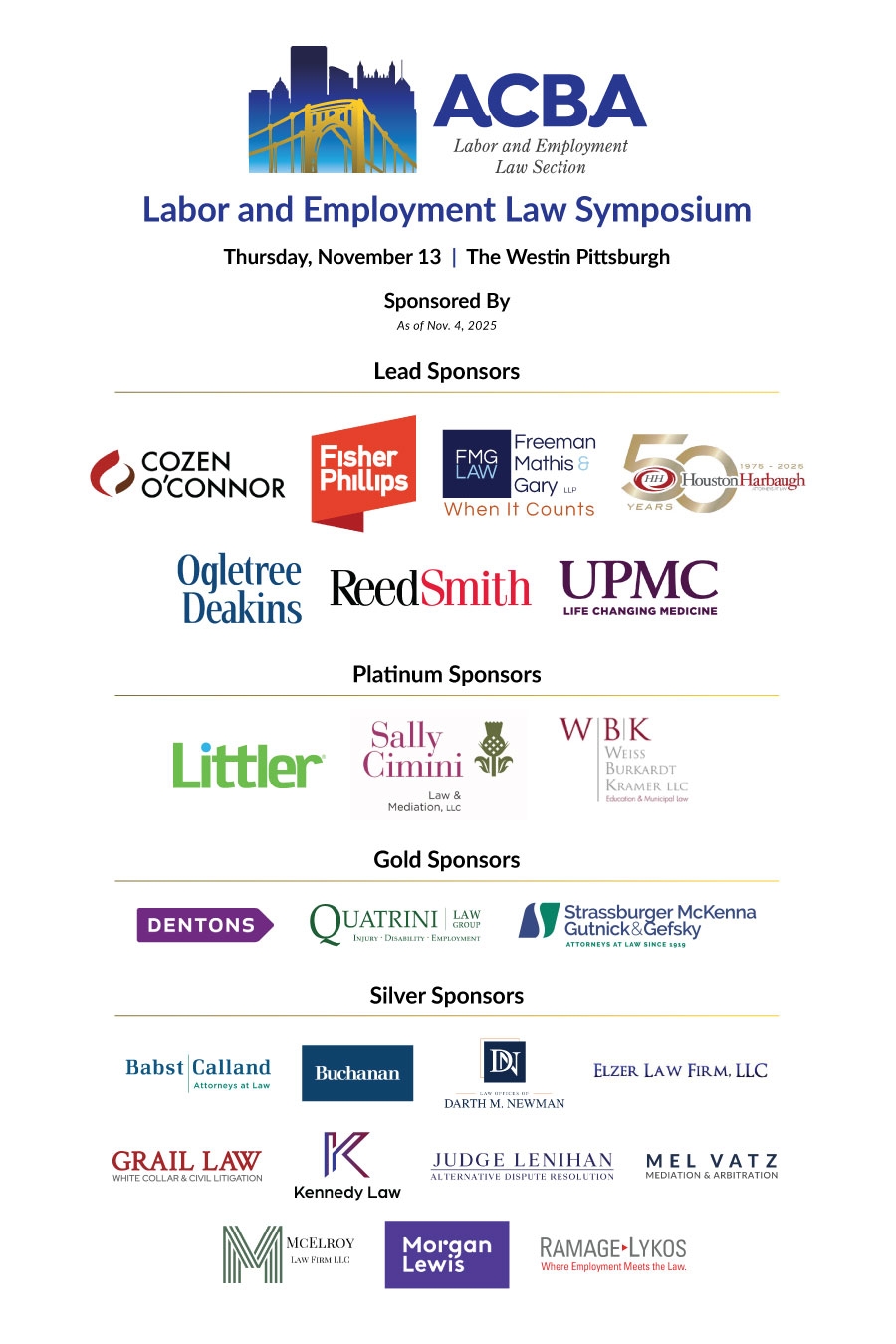
Sponsored by:
Registration Options
Early bird registration (by Friday, Oct. 18)
$429 – ACBA Member
$385 – ACBA Member Half Day Rate
$519 – Non-ACBA Member
$475 – Non-ACBA Member Half Day Rate
$109 – ACBA Law Students
Standard (Oct. 18 to Nov. 7)
$469 – ACBA Member
$425 – ACBA Member Half Day Rate
$559 – Non-ACBA Member
$515 – Non-ACBA Member Half Day Rate
$109 – ACBA Law Students
Walk-In Registration (Nov. 7 to Nov. 13)
$529 – ACBA Member
$485 – ACBA Member Half Day Rate
$619 – Non-ACBA Member
$575 – Non-ACBA Member Half Day Rate
$109 – ACBA Law Students